Page 286 - NHB AR 2020-21-3 complete- Print (1)
P. 286
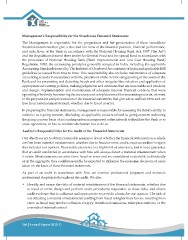
Management’s Responsibility for the Standalone Financial Statements
The Management is responsible for the preparation and fair presentation of these standalone
financial statements that give a true and fair view of the financial position, financial performance,
and cash flows of the Bank in accordance with the National Housing Bank Act, 1987 (‘the Act’)
and the Regulations framed there under for General Fund and for special fund in accordance with
the provisions of National Housing Bank (Slum Improvements and Low Cost Housing Fund)
Regulation, 1993, the accounting principles generally accepted in India, including the applicable
Accounting Standards issued by The Institute of Chartered Accountants of India and applicable RBI
guidelines as issued from time to time. This responsibility also includes maintenance of adequate
accounting records in accordance with the provisions of the Act for safeguarding of the assets of the
Bank and for preventing and detecting frauds and other irregularities; selection and application of
appropriate accounting policies; making judgments and estimates that are reasonable and prudent;
and design, implementation and maintenance of adequate internal financial controls, that were
operating effectively for ensuring the accuracy and completeness of the accounting records, relevant
to the preparation and presentation of the financial statements that give a true and fair view and are
free from material misstatement, whether due to fraud or error.
In preparing the financial statements, management is responsible for assessing the Bank’s ability to
continue as a going concern, disclosing, as applicable, matters related to going concern and using
the going concern basis of accounting unless management either intends to liquidate the Bank or to
cease operations, or has no realistic alternative but to do so.
Auditor’s Responsibilities for the Audit of the Financial Statements
Our objectives are to obtain reasonable assurance about whether the financial statements as a whole
are free from material misstatement, whether due to fraud or error, and to issue an auditor’s report
that includes our opinion. Reasonable assurance is a high level of assurance, but is not a guarantee
that an audit conducted in accordance with SAs will always detect a material misstatement when
it exists. Misstatements can arise from fraud or error and are considered material if, individually
or in the aggregate, they could reasonably be expected to influence the economic decisions of users
taken on the basis of these financial statements.
As part of an audit in accordance with SAs, we exercise professional judgment and maintain
professional skepticism throughout the audit. We also:
• Identify and assess the risks of material misstatement of the financial statements, whether due
to fraud or error, design and perform audit procedures responsive to those risks, and obtain
audit evidence that is sufficient and appropriate to provide a basis for our opinion. The risk of
not detecting a material misstatement resulting from fraud is higher than for one resulting from
error, as fraud may involve collusion, forgery, intentional omissions, misrepresentations, or the
override of internal control.
266 | Annual Report 2020-21
The Management is responsible for the preparation and fair presentation of these standalone
financial statements that give a true and fair view of the financial position, financial performance,
and cash flows of the Bank in accordance with the National Housing Bank Act, 1987 (‘the Act’)
and the Regulations framed there under for General Fund and for special fund in accordance with
the provisions of National Housing Bank (Slum Improvements and Low Cost Housing Fund)
Regulation, 1993, the accounting principles generally accepted in India, including the applicable
Accounting Standards issued by The Institute of Chartered Accountants of India and applicable RBI
guidelines as issued from time to time. This responsibility also includes maintenance of adequate
accounting records in accordance with the provisions of the Act for safeguarding of the assets of the
Bank and for preventing and detecting frauds and other irregularities; selection and application of
appropriate accounting policies; making judgments and estimates that are reasonable and prudent;
and design, implementation and maintenance of adequate internal financial controls, that were
operating effectively for ensuring the accuracy and completeness of the accounting records, relevant
to the preparation and presentation of the financial statements that give a true and fair view and are
free from material misstatement, whether due to fraud or error.
In preparing the financial statements, management is responsible for assessing the Bank’s ability to
continue as a going concern, disclosing, as applicable, matters related to going concern and using
the going concern basis of accounting unless management either intends to liquidate the Bank or to
cease operations, or has no realistic alternative but to do so.
Auditor’s Responsibilities for the Audit of the Financial Statements
Our objectives are to obtain reasonable assurance about whether the financial statements as a whole
are free from material misstatement, whether due to fraud or error, and to issue an auditor’s report
that includes our opinion. Reasonable assurance is a high level of assurance, but is not a guarantee
that an audit conducted in accordance with SAs will always detect a material misstatement when
it exists. Misstatements can arise from fraud or error and are considered material if, individually
or in the aggregate, they could reasonably be expected to influence the economic decisions of users
taken on the basis of these financial statements.
As part of an audit in accordance with SAs, we exercise professional judgment and maintain
professional skepticism throughout the audit. We also:
• Identify and assess the risks of material misstatement of the financial statements, whether due
to fraud or error, design and perform audit procedures responsive to those risks, and obtain
audit evidence that is sufficient and appropriate to provide a basis for our opinion. The risk of
not detecting a material misstatement resulting from fraud is higher than for one resulting from
error, as fraud may involve collusion, forgery, intentional omissions, misrepresentations, or the
override of internal control.
266 | Annual Report 2020-21